
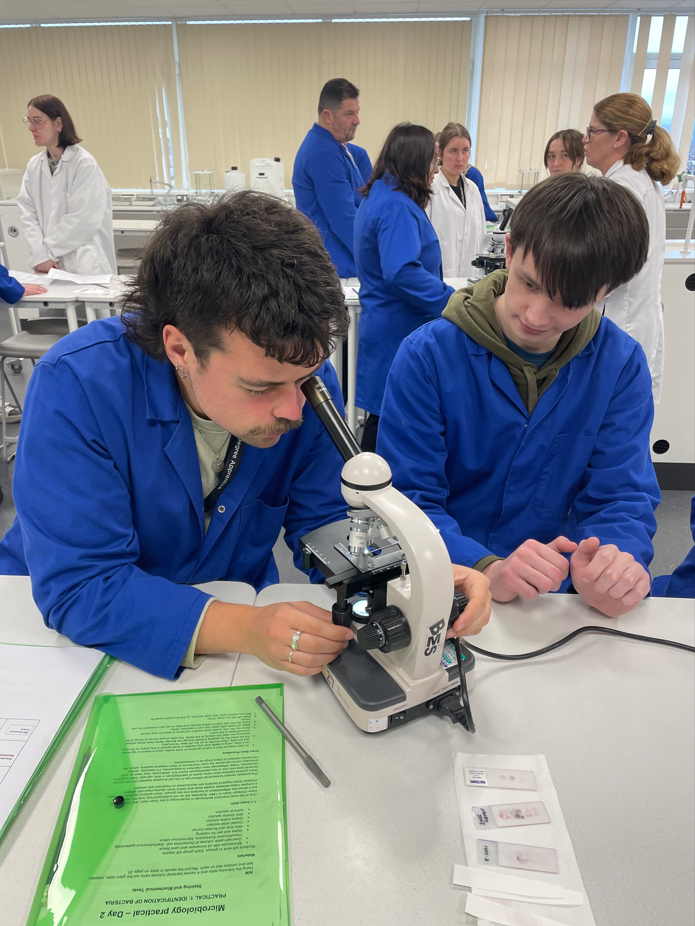
Over the February half-term, BSc Environmental Health Practitioners (Apprentices) and BSc Public and Environmental Health full-time students were given the valuable opportunity to participate in a series of hands-on Microbiology practical sessions in the laboratory at UCW. These sessions were designed to enhance their understanding of core microbiological principles while developing essential laboratory skills that are fundamental to professional practice within public and environmental health. Microbiology underpins many EH functions, from water quality monitoring and food microbiology to antimicrobial resistance (AMR) surveillance, microbial disease outbreak investigations, and environmental contamination assessments, making these competencies essential for future practitioners.
A key focus of the week involved mastering fundamental bacterial culture techniques. Students practised streak plate and spread plate methods to isolate and quantify microorganisms, gaining insight into how environmental and food samples are processed in real-world investigations. They also worked with Saccharomyces cerevisiae (baker’s yeast), an ideal model organism for understanding microbial growth dynamics, contamination risks, and fermentation processes relevant to food safety and environmental monitoring.
Building on these foundational skills, learners carried out Gram staining and performed catalase and oxidase tests on overnight plate cultures. The bacterial species investigated included Escherichia coli, Staphylococcus epidermidis, Pseudomonas fluorescens, and Micrococcus luteus. Students also used selective and differential media to understand how microbiologists distinguish pathogens from commensals in complex environmental or food samples. These activities enabled them to observe differences in cell wall structure, enzyme activity, and metabolic characteristics, helping them distinguish between Gram-positive and Gram-negative organisms and interpret biochemical reactions with confidence.
The sessions also introduced the principles of antimicrobial susceptibility testing (AST), a cornerstone of AMR monitoring and outbreak response. Students performed AST using nutrient agar, a range of bacterial species, and both broad-spectrum and narrow-spectrum antibiotics to explore patterns of bacterial sensitivity and resistance. Understanding how bacteria respond to antimicrobial agents is vital for Environmental Health Professionals involved in foodborne illness investigations, infection control, and public health risk assessments. By engaging with these techniques, students developed a clearer appreciation of how laboratory evidence informs regulatory decisions and environmental health interventions.
These practical sessions not only reinforced theoretical knowledge delivered in lectures but also provided students with the opportunity to apply scientific techniques in a controlled laboratory environment. For degree apprentices in particular, this was an invaluable chance to refine aseptic technique, practise safe handling of microbiological samples, and build confidence with laboratory equipment. Engaging directly with these procedures strengthened their understanding of how microbiological analysis underpins environmental health investigations, from water testing and food microbiology to housing-related contamination and workplace hygiene assessments.
Overall, the half-term practical activities were both engaging and professionally enriching, equipping learners with practical competencies that will support their academic progression and future careers in public and environmental health.